Spreadsheets, Venmo, or group texts — none of it works
And why the "system" you came up with isn't a system
Child support covers the basics. Rent. Food. Utilities. That part is usually settled by the court.
Then there's everything else.
- Orthodontist. $2,400.
- Soccer league. $500 per season.
- School supplies in September. $200.
- Urgent care copay. $75.
- Summer camp. $1,500.
- New glasses. $250.
Who pays for these? Is it covered by child support? Split 50/50? Pro rata based on income? Depends on the parenting plan?
In most states, these are called "unreimbursed expenses" — medical bills, extracurriculars, school fees, childcare — and they sit in a gray zone between child support and goodwill. Some parenting plans spell out a split. Many don't. And even when they do, the plan says how much each parent owes. It doesn't say how to track it.
That's where it falls apart.
Venmo is not an expense tracker
Venmo is a payment app. It moves money. That's it.
When you use Venmo to split your kid's expenses:
- "$75" with a soccer ball emoji is not a documented expense
- there's no approval process — you just get a charge
- there's no running balance of who owes what overall
- three months later, you can't tell if that $120 was for the dentist or the field trip
- and if your co-parent disputes it, you're scrolling through six months of transactions looking for context
Venmo tells you money moved. It doesn't tell you why. It doesn't track what's been agreed on. It doesn't show what's pending.
A Venmo history is not documentation. It's a list of numbers with emojis.
The spreadsheet. Everyone's first idea.
Google Sheets. Excel. It looks organized. Columns for date, description, amount, who paid, who owes. Maybe even a formula that calculates the balance.
It works for about two weeks.
Then:
- One parent stops updating it.
- The other parent doesn't trust the numbers.
- There's no approval — just rows someone typed in.
- There's no notification when something gets added.
- Someone edits a cell and now last month's totals don't match.
A shared spreadsheet between two people who broke up is an invitation for conflict. Who changed that number? When? Why was the balance $340 last week and now it's $280?
Spreadsheets don't have an audit trail. They don't have a concept of "approved" or "pending." They're flat files. And flat files don't solve trust problems.
The text thread. The worst of all.
Some parents handle expenses over text. Or iMessage. Or a dedicated WhatsApp group.
This means:
- "I paid $180 for the dentist" lives between "pick her up at 6" and "she forgot her jacket"
- there's no status — was it acknowledged? Accepted? Disputed?
- there's no running total
- there's no export for your attorney or mediator
- and six months of expenses are buried in a thread you'd rather not reopen
A message is a moment. It's not a record. The fact that it was sent doesn't mean it was agreed to.
On Reddit, in r/coparenting and r/custody, you'll find hundreds of threads where parents are trying to prove what they paid using screenshots. Screenshots of texts. Screenshots of bank statements. Screenshots of receipts taped together in a photo collage.
That's not a system. That's a cry for help.
"We'll just figure it out" is not a plan
The most common approach to splitting unreimbursed expenses is no approach at all.
"I'll cover soccer, you cover dance, and we'll sort the rest out later."
Later. That word carries more conflict than any dollar amount.
This works until September hits and you've got school supplies, new shoes, a backpack, a physical exam copay, and registration fees for two activities — all in the same month. And no one knows who's ahead.
Without a shared record, there's no shared reality. One parent thinks they're owed $400. The other thinks it's $150. Both are frustrated. Neither has proof.
And when it's time to revisit child support or go back to court for a modification, the judge wants to see actual expenses. Not estimates. Not "I think I spent around…" Numbers. Dates. Categories.
What you actually need
Not much. But exactly this:
- Both parents see the same data. Not "my version" and "your version."
- Every expense has an amount, a date, a category, and a note.
- Every expense requires approval from the other parent. Not "read." Approved.
- There's a running balance. Clear. Current. No math required.
- When an expense is added, the other parent gets a notification.
- When something needs approval, you know about it.
- You can export it. PDF. CSV. For yourself, for your attorney, for your mediator, for your peace of mind.
- And when it's time for a child support review, you have 12 months of documented expenses. Not guesses. Data.
That's not complicated. But no chat app, spreadsheet, or payment platform does all of this.
It's not about control. It's about not having to guess.
When both parents see the same numbers:
- no one needs to prove anything
- no one needs to scroll
- no one needs to send reminders
- no one needs to argue about what was "said" three months ago
Numbers are numbers. They either add up or they don't. And when you both see them, there's nothing left to fight about.
Simple. Clear. Done.
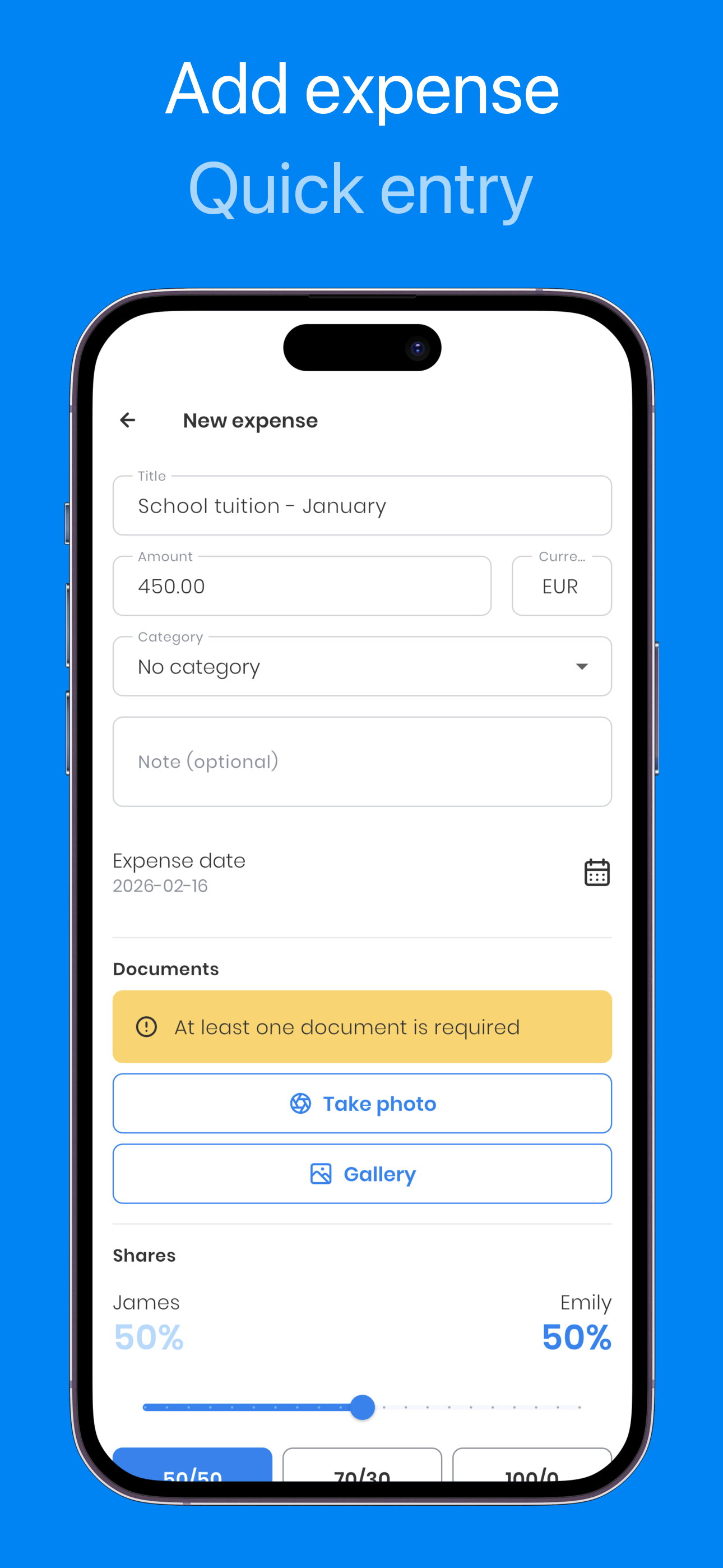
Duo — Child Expense Tracker
Track shared child expenses. Approvals. Running balance. Notifications. Free for iOS and Android.