Why Co-Parents Fight After a Breakup
And why it's almost never about the money
After a breakup, you can figure out a lot of things.
- Custody schedule.
- School logistics.
- Day-to-day routines.
But the most common conflict? Money.
Not the big stuff. The small stuff.
- Lunch money.
- Soccer registration.
- A copay at the pediatrician.
- New sneakers.
The problem is rarely the amount. The problem is uncertainty.
The conflict doesn't start with a number. It starts with a doubt.
Typical situation:
"I paid for soccer registration."
Jessica
"How much was it?"
Mike
"I told you last week."
Jessica
"You didn't."
Mike
And just like that, there's tension. Not because of the amount. But because one parent has no context. They can't see:
- the receipt
- the date
- a note
- whether they're expected to pay half
- whether it's already been covered
- who paid
Just a number. And a number without context creates suspicion.
Most conflicts don't come from bad intentions
Most parents don't want to hurt their kids. Conflict shows up when:
- it's unclear what counts as a shared expense
- it's unclear who paid for what
- it's unclear what still needs to be reimbursed
- it's unclear whether the other parent even saw the expense
- it's unclear what stage a payment is in
Without a shared record, there's no shared reality. And when there's no shared reality, everyone builds their own.
Why texting doesn't work for this
Texting was designed for conversation. Not for tracking.
When expenses are handled over text:
- they get mixed in with everything else
- they have no clear status
- they can't be filtered
- they can't be summarized
- they get buried in the thread
A message can be read. That doesn't mean it was understood. That doesn't mean it was agreed to. That doesn't mean anyone's acting on it.
A notification is a moment. A record is a system.
The silent source of conflict: invisible status
Every expense has stages:
- One parent reports it
- The other is expected to respond
- They agree
- Someone pays
- It's settled
If those stages aren't visible to both parents, tension builds.
"I thought that was taken care of."
"I was waiting for you to respond."
"I didn't know I was supposed to pay."
Without a clear status, everyone fills in the blanks with their own story.
Child support doesn't cover everything. That's where it gets messy.
Most custody agreements include child support. But in practice:
- child support covers the basics, not the extras
- extracurriculars, medical copays, school supplies, clothes — that's all on top
- many agreements say "split 50/50" for extras, but there's no system to track it
- one parent pays upfront and hopes to get reimbursed
- the other parent doesn't even know the expense happened
It doesn't matter how solid the custody agreement is. Day-to-day expenses need their own record.
The parent who pays has no proof it was shared. The parent who owes has no way to know what's outstanding. Both lose.
Uncertainty costs more than the expenses themselves
When a parent doesn't have clarity, they start to:
- double-check everything
- question everything
- ask for receipts for every little thing
- delay payments
- react emotionally
That costs time. Energy. The relationship. And eventually, money too.
The tension carries over. Even when it's "just over text."
What it means to have a system
A system means:
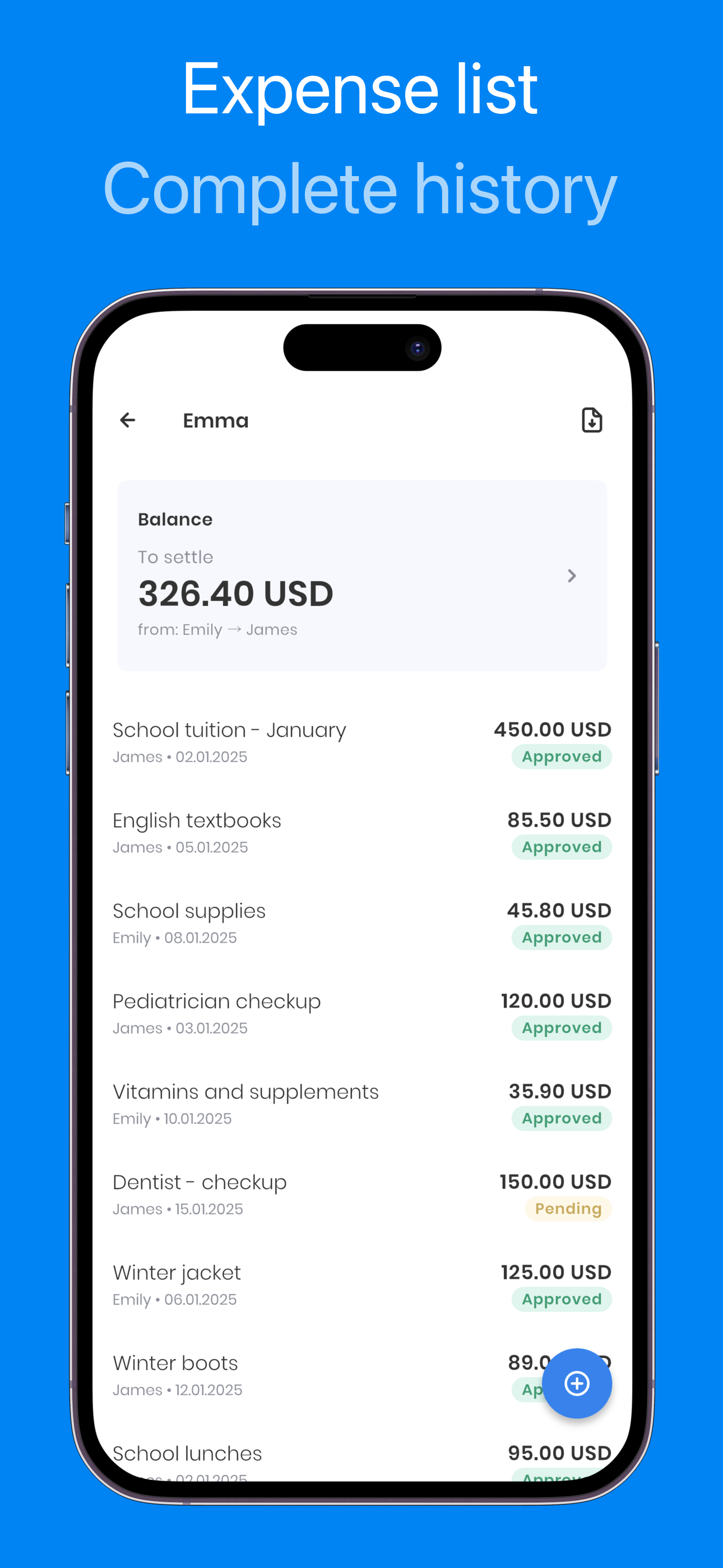
- every expense is a separate entry
- it has a clear amount
- it has a date
- it has a category
- it has a note or receipt
- it has a current status
- it's visible to both parents
It's not "somewhere in a message." It's recorded.
Both parents see the same data.
That changes the dynamic.
What changes when everything is visible
When a shared record exists:
- suspicion goes down
- the need to prove things goes down
- the "I didn't know" argument disappears
- the same questions stop repeating
- the conversation moves from assumptions to facts
It doesn't mean all disagreements disappear.
It means both parents start from the same information.
And that's a fundamental difference.
Stability for your kid starts between the parents
A child doesn't need to know who paid for the field trip.
They need stability.
Every money conflict chips away at that stability. Even the quiet ones.
If both parents share responsibility for their kids, they should share a clear record of the costs too.
Not for control. To remove uncertainty.
The bottom line
Expenses aren't the main problem. Uncertainty is.
When you remove uncertainty:
- fewer questions
- less tension
- fewer fights
A system doesn't replace the relationship. But it keeps every receipt from turning into an argument.
Simple. Clear. Straightforward.