
And why most parents don't actually know
The USDA says roughly $320,000 to raise a child from birth to age 17. Adjusted for inflation, that's about $18,800 a year. Around $1,560 a month.
But that's a national average. In Mississippi, it's closer to $19,000 a year. In Massachusetts, it's over $44,000. Where you live changes everything.
And college? Not included.
Both numbers are averages. And averages lie.
What's hiding behind the average
Baby: diapers at $70–80 a month, formula at $50–150, clothes that last two months, a crib, a stroller, a car seat. First-year costs catch every parent off guard. Every single one.
Toddler: daycare or a nanny. This is where it hits. Daycare runs $700 to $1,500 a month depending on where you live. A nanny? $800 a week or more. Childcare alone eats 16% of total child-rearing costs — and for many families, it's the biggest monthly expense after housing.
School-age: supplies, clothes, after-school programs, sports fees, field trips. September is the month everything lands at once. Backpack, shoes, lunch money, registration fees. Then comes the ski trip, the class photo, the fundraiser.
Teenager: phone, brand-name clothes, their own transportation, outings with friends. Costs don't go down with age. They go up.
College: tuition, books, room and board. Average cost at a public four-year university is over $24,000 a year. Private? Over $56,000. And that's before loans.
Now split all of that in two
When parents live together, it's one budget. When they separate, it's two. And suddenly it matters who paid for what.
A court sets child support. Let's say $500 to $1,500 a month, depending on income and custody. But child support doesn't cover everything.
Braces at $5,000. New glasses at $300. Soccer registration at $250. A school field trip at $85. A winter jacket at $120.
These are "additional" or "extraordinary" expenses. In most states, they're split between both parents. Sometimes the court decides. Sometimes it's an agreement. Either way, someone has to keep track.
The problem isn't the amount. It's that nobody knows it.
Ask a divorced parent: "How much did your child cost you over the last six months?"
The answer will be: "A lot." Or: "I'm not sure exactly." Or: "More than the other parent thinks."
Nobody knows. Because nobody tracks it.
And when nobody tracks it, the arguments start. Not about numbers. About feelings. "I pay for everything." "That's not true." "Prove it."
In co-parenting forums, there are hundreds of threads where mothers are looking for ways to prove what they spent. Bank screenshots. Pharmacy receipts. Photos of bills.
Because there isn't one single number both parents agree on.
The court wants data, not feelings
When it's time for a child support review, the judge asks: what are the actual expenses for the child?
They look at food, housing, clothing, healthcare, education, activities, transportation, personal care. Everything.
Family lawyers recommend gathering receipts, invoices, and payment confirmations. The more detail, the better.
But who's going to reconstruct twelve months of expenses from receipts, texts, and memory?
Whoever tracks it from the start has the answer instantly.
$1,560 a month is an average. Your month is specific.
The average doesn't know that in September you paid $400 for school supplies, in November $300 for glasses, and in January $250 for soccer registration. All on top of the usual.
An average is a statistic. Your budget is reality. And reality can't be managed by averages.
When you have your own numbers — real numbers — you know:
- how much you spent this month
- how much was shared
- how much each parent paid
- what the running balance is
And when both parents know that, there's nothing to guess.
The bottom line
A child costs money. How much exactly depends on the month, the age, the situation. The national average of $320,000 is a reference point. Reality is different.
If you don't track, you guess. If you guess, you argue. And arguments become conflict.
Tracking isn't control. It's an answer to a question that otherwise nobody can answer.
Simple. Clear. Straightforward.
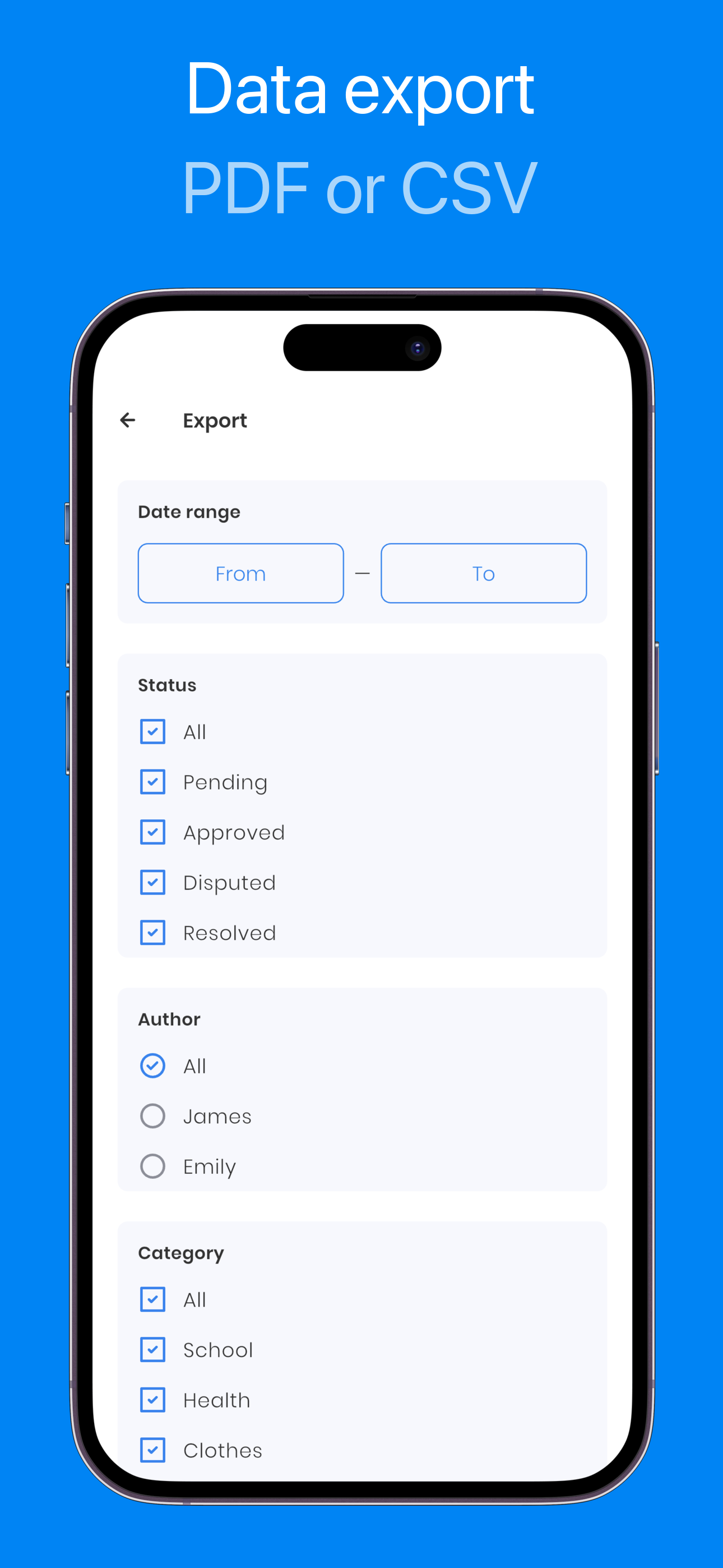
Duo — Child Expense Tracker
Track shared child expenses. Approvals. Running balance. Notifications. Free for iOS and Android.